Breaking the mold in pain biology

At Adneuris, we are pioneering a fundamentally different approach to pain biology modulation: the dual-NMR agonist.
Dual-NMR agonist compounds have the potential to deliver gold-standard pain relief with a strong safety profile.

Current treatments for moderate-to-severe pain involving conventional opioids have well-described adverse effects that may largely derive from preferentially targeting the MOP receptor.1 By leveraging the coactivation of NOP and MOP, dual-NMR agonists synergize the pain relief and safety characteristics of the NOP receptor with the analgesic advantages of the MOP receptor.2,3 Our investigational dual-NMR agonist, cebranopadol, has been well-characterized and studied in over 2,200 adults across 33 trials, including two pivotal Phase 3 trials in acute pain.4,5 Tris also plans to conduct Phase 3 trials in chronic pain.

Activating both NOP and MOP receptors, dual-NMR agonists have the potential to deliver significant pain relief with mitigated side effects.2

NOP receptor activation produces distinct pharmacological effects and plays a crucial role in modulating the side effects typically associated with preferential MOP agonists.2 

By simultaneously activating both NOP and MOP receptors, data demonstrate that dual-NMR agonists have the promise to deliver potent pain relief while leveraging the NOP receptor’s modulatory action to reduce the adverse effects linked to preferential MOP or NOP agonism alone. Despite this potential, targeting the NOP receptor alone has not proven to be a superior pain management strategy and has been associated with its own set of side effects.3 

Dual NMR agonists’ synergistic co-activation offers a more promising pathway with data demonstrating the ability to achieve strong pain relief with a safer therapeutic profile2,6 characterized by:

  • Reduced abuse potential
  • Lowered risk of developing tolerance and withdrawal symptoms
  • Less incidence of respiratory depression

How do dual-NMR agonists differ from conventional opioid therapy?
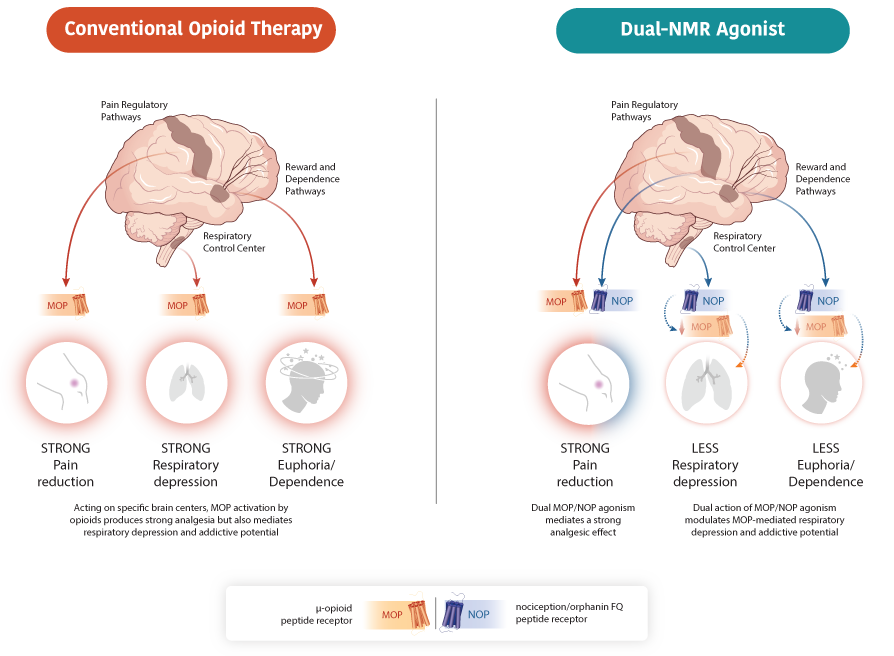
Convertional Opioid Therapy vs Dual-NMR Agonist

Data demonstrate that novel Dual-NMR agonists may provide significant benefits over preferential MOP agonists offering hope for patients with serious pain.

Recent clinical results add to the growing body of data underscoring the promising efficacy and safety profile of cebranopadol,4,5 a first-in-class dual NMR agonist that simultaneously activates the nociceptin/orphanin FQ peptide (NOP) receptor and µ-opioid peptide (MOP) receptor to treat pain.

Our investigational dual-NMR agonist, cebranopadol, has been well-characterized and studied in approximately 2,200 adults across 33 trials, including two pivotal Phase 3 trials in acute pain. With these positive results in hand, plans to conduct Phase 3 trials in chronic pain are underway.

References:

  1. Dowell D, Ragan KR, Jones CM, Baldwin GT, Chou R. CDC clinical practice guideline for prescribing opioids for pain – United States, 2022. MMWR RecommRep. 2022;71(3):1-95.
  2. Kiguchi N, Ding H, Ko MC. Therapeutic potentials of NOP and MOP receptor coactivation for the treatment of pain and opioid abuse. J NeurosciRes. 2022 Jan;100(1):191-202.
  3. Morairty SR, Sun Y, Toll L, Bruchas MR, Kilduff TS. Activation of the nociceptin/orphanin-FQ receptor promotes NREM sleep and EEG slow wave activity. Proc Natl AcadSci USA. 2023;120(13):e2214171120
  4. Data on file. Tris Pharma, Inc. January 22, 2025.
  5. Singla N, Minkowitz H, Vaughn B, Grieco J, Lesnick M, Hackworth J. Results of a randomized, placebo-controlled, Phase 3 trial of cebranopadol for the treatment of acute pain after abdominoplasty. Presented at: The American Society of Regional Anesthesia (ASRA); May 2025.
  6. Linz K, Schiene K, Englberger W, Wappner M, Wichelhaus R. Opioid-type respiratory depressant side effects of cebranopadol in rats are limited by its nociceptin/orphanin FQ peptide receptor agonist activity. Anesthesiology. 2017;126(4):708-715.

Cebranopadol is an investigational first-in-class analgesic in clinical development for the treatment of moderate-to-severe pain. Its novel mechanism has the potential to transform pain treatment so that patients can obtain relief with minimized risk of significant side effects. To date, cebranopadol has been studied in over 2,200 adults across 33 clinical trials with data demonstrating a promising efficacy and safety profile.

Cebranopadol’s novel mechanism of action targets two key receptors, the nociceptin/orphanin FQ peptide (NOP) and µ-opioid peptide (MOP) receptors. These receptors play complementary and distinct roles to modulate pain biology, synergizing the analgesic and safety characteristics of the NOP receptor with the analgesic advantages of the MOP receptor.

The human body utilizes sophisticated pain modulation pathways with key receptors that receive and transmit pain signals. Two of these key receptors are the NOP and the MOP receptors, which co-localize in the brain to work together to regulate pain.1 Current treatments for moderate-to-severe pain involving conventional opioids have well-described adverse effects that may largely derive from preferentially targeting the MOP receptor.2 Activation of the NOP receptor has demonstrated distinct and complementary effects to MOP, resulting in less respiratory depression, less stimulation of the brain reward pathway and less euphoria.1 This coactivation of NOP and MOP receptors (“dual-NMR”) is the key to cebranopadol’s unique mechanism of action.

References:
1. Toll L, Bruchas MR, Caló G, Cox BM, Zaveri NT. Nociceptin/orphanin FQ receptor structure, signaling, ligands, functions, and interactions with opioid systems. Pharmacol Rev. 2016 Apr;68(2):419-57.
2. Dowell D, Ragan KR, Jones CM, Baldwin GT, Chou R. CDC clinical practice guideline for prescribing opioids for pain – United States, 2022. MMWR Recomm Rep. 2022;71(3):1-95.

In clinical trials to date, cebranopadol has exhibited significant efficacy and has the potential to address an unmet medical need for patients suffering from pain. With its novel, dual-NMR mechanism of action, cebranopadol offers the potential to effectively treat moderate-to-severe pain with reduced risk of side effects such as:

  • Reduced abuse potential1,2
  • Lowered risk of developing tolerance and withdrawal symptoms
  • Less incidence of respiratory depression3

References:
1. Shram M, Apseloff G, Grieco J, Fam D, Lesnick M, Hackworth J. Abuse potential assessment of cebranopadol, a novel eual nociceptin (NOP) and Mu opioid (MOP) receptor (NMR) agonist: Implications for scheduling. Presented at: The College on Problems of Drug Dependence; June 2025. 
2. Apseloff G, Pardo A, Shram M, Grieco JC, Lesnick ML, Hackworth JC. Limited oral abuse potential of cebranopadol, a novel potent analgesic, compared to tramadol and oxycodone in recreational opioid users. Presented at: PainWeek; September 2023. 
3. Jansen S, Olofsen E, Moss L, et al. Respiratory and antinociceptive effects of a dual NOP-MOP receptor agonist cebranopadol versus full opioid receptor agonist oxycodone: a comparison in healthy volunteers. Anesthesiology. Published online December 11, 2025. doi:10.1097/ALN.0000000000005894

Two cebranopadol human abuse potential studies conducted head-to head against Class-II and Class-IV opioids have demonstrated that cebranopadol-treated subjects, even at supratherapeutic doses, showed less abuse potential as measured by drug-liking.1-2 Moreover, data to date suggest that cebranopadol does not produce meaningful physical dependence.3 In studies of subjects treated with cebranopadol for up to 14 weeks, abrupt discontinuation of cebranopadol did not require tapering or cause patients to exhibit clinically relevant withdrawal symptoms.3

Cebranopadol’s novel mechanism of action also lends promise in treating patients with substance use disorders. The National Institutes of Health (NIH) has awarded Adneuris Therapeutics a grant up to $16.6 million to study cebranopadol as a potential treatment for opioid use disorder.

References:
1. Apseloff G, Pardo A, Shram M, Grieco JC, Lesnick ML, Hackworth JC. Limited oral abuse potential of cebranopadol, a novel potent analgesic, compared to tramadol and oxycodone in recreational opioid users. Presented at: PainWeek; September 2023. 
2. Shram M, Apseloff G, Grieco J, Fam D, Lesnick M, Hackworth J. Abuse potential assessment of cebranopadol, a novel eual nociceptin (NOP) and Mu opioid (MOP) receptor (NMR) agonist: Implications for scheduling. Presented at: The College on Problems of Drug Dependence; June 2025. 
3. Fam D, Pardo A, Hackworth J. Cebranopadol, a novel potent analgesic: Pooled analysis of clinical opiate withdrawal scales. Presented at: PainWeek; September 2022.

Adneuris Therapeutics anticipates submitting an NDA for the treatment of moderate-to-severe acute pain in 2026.

In Q1 2025, Adneuris conducted two registrational acute pain trials in patients following abdominoplasty and bunionectomy surgeries. These data are foundational to discussions with regulators in anticipation of NDA submission. For data and more information about these trials, see the press releases in the News section of this website.

Adneuris anticipates conducting clinical trials in chronic pain conditions, including neuropathic pain. Cebranopadol has been granted Fast Track Designation for chronic low back pain. In addition, the National Institutes of Health (NIH) has awarded Adneuris Therapeutics grant up to $16.6 million to study cebranopadol as a potential treatment for opioid use disorder.

Neuron image: Dual-NMR agonism - A novel approach to treating pain and addiction.